Cambridge Ielts 11 Reading Test 1 Pdf
READING PASSAGE 1
You should spend virtually 20 minutes on Questions 1-thirteen which are based on Reading Passage 1 below.
Ingather-growing skyscrapers
By the year 2050, about 80% of the Earth's population will alive in urban centres. Applying the most conservative estimates to current demographic trends, the human population will increment by nigh iii billion people by so. An estimated 109 hectares of new land (about 20% larger than Brazil) will be needed to grow enough food to feed them, if traditional farming methods continue as they are practised today. At present, throughout the world, over 80% of the land that is suitable for raising crops is in use. Historically, some 15% of that has been laid waste past poor management practices. What can be washed to ensure enough nutrient for the world's population to live on?
The concept of indoor farming is non new, since hothouse production of tomatoes and other produce has been in vogue for some time. What is new is the urgent need to scale upwardly this technology to accommodate another three billion people. Many believe an entirely new approach to indoor farming is required, employing cutting-edge technologies. One such proposal is for the 'Vertical Farm'. The concept is of multi-storey buildings in which food crops are grown in environmentally controlled weather condition. Situated in the center of urban centres, they would drastically reduce the amount of transportation required to bring food to consumers. Vertical farms would demand to be efficient, cheap to construct and prophylactic to operate. If successfully implemented, proponents claim, vertical farms offer the hope of urban renewal, sustainable production of a safe and varied food supply (through twelvemonth-round product of all crops), and the eventual repair of ecosystems that have been sacrificed for horizontal farming.
It took humans 10,000 years to learn how to abound most of the crops nosotros at present take for granted. Forth the way, nosotros despoiled nearly of the country nosotros worked, often turning verdant, natural ecozones into semi-arid deserts. Within that same time frame, we evolved into an urban species, in which 60% of the human population at present lives vertically in cities. This means that, for the majority, we humans have shelter from the elements, nonetheless we field of study our nutrient-bearing plants to the rigours of the neat outdoors and can practise no more than hope for a skillful weather year. However, by and large now, due to a rapidly irresolute climate, that is non what happens. Massive floods, long droughts, hurricanes and severe monsoons take their toll each yr, destroying millions of tons of valuable crops.
The supporters of vertical farming claim many potential advantages for the system. For instance, crops would be produced all twelvemonth round, as they would exist kept in artificially controlled, optimum growing conditions. There would be no weather-related crop failures due to droughts, floods or pests. All the food could be grown organically, eliminating the need for herbicides, pesticides and fertilisers. The organization would greatly reduce the incidence of many infectious diseases that are acquired at the agricultural interface. Although the system would consume free energy, it would render free energy to the grid via methyl hydride generation from composting nonedible parts of plants. It would also dramatically reduce fossil fuel use, by cutting out the need for tractors, ploughs and aircraft.
A major drawback of vertical farming, however, is that the plants would require artificial light. Without it, those plants nearest the windows would be exposed to more sunlight and abound more apace, reducing the efficiency of the system. Unmarried-storey greenhouses have the do good of natural overhead low-cal; fifty-fifty so, many still demand artificial lighting.
A multi-storey facility with no natural overhead low-cal would require far more. Generating enough light could be prohibitively expensive, unless cheap, renewable energy is available, and this appears to be rather a future aspiration than a likelihood for the near futurity.
I variation on vertical farming that has been developed is to abound plants in stacked trays that movement on rails. Moving the trays allows the plants to get enough sunlight. This system is already in operation, and works well within a single-storey greenhouse with calorie-free reaching it from above: it Is not certain, however, that it can exist made to work without that overhead natural light.
Vertical farming is an endeavor to address the undoubted issues that nosotros face in producing enough food for a growing population. At the moment, though, more than needs to be done to reduce the detrimental affect it would accept on the environs, particularly equally regards the utilise of free energy. While information technology is possible that much of our food will exist grown in skyscrapers in future, nearly experts currently believe it is far more likely that we volition simply utilize the space available on urban rooftops.
Questions 1-7
Complete the sentences below.
Choose NO More than 2 WORDS from the passage for each answer.
Write your answers in boxes 1-7 on your reply sheet.
Indoor farming
one Some food plants, including……………… are already grown indoors.
2 Vertical farms would be located in………………, meaning that in that location would exist less need to have them long distances to customers.
3 Vertical farms could use methane from plants and animals to produce………………..
4 The consumption of………………… would be cut because agronomical vehicles would be unnecessary.
five The fact that vertical farms would demand……………….. light is a disadvantage.
6 One class of vertical farming involves planting in……………….. which are not fixed.
seven The most probable development is that food will be grown on………………… in towns and cities.
Questions 8-thirteen
Do the following statements agree with the information given in Reading Passage?
In boxes 8-13 on your answer sheet, write
TRUE if the statement agrees with the information
Simulated if the argument contradicts the information
NOT GIVEN if there is no information on this
viii Methods for predicting the Earth'south population have recently changed.
9 Human beings are responsible for some of the destruction to food-producing land.
ten The crops produced in vertical farms will depend on the season.
11 Some damage to nutrient crops is caused past climate change.
12 Fertilisers will be needed for sure crops in vertical farms.
xiii Vertical farming will make plants less likely to exist affected by infectious diseases.
READING PASSAGE two
Y'all should spend about xx minutes on Questions fourteen-26 which are based on Reading Passage ii below.
The Falkirk Wheel
A unique engineering accomplishment
The Falkirk Cycle in Scotland is the earth's get-go and just rotating boat elevator. Opened in 2002, information technology is central to the ambitious £84.5m Millennium Link project to restore navigability beyond Scotland by reconnecting the historic waterways of the Forth & Clyde and Spousal relationship Canals.
The major challenge of the projection lays in the fact that the Forth & Clyde Canal is situated 35 metres below the level of the Union Canal. Historically, the ii canals had been joined about the town of Falkirk by a sequence of eleven locks – enclosed sections of canal in which the water level could exist raised or lowered – that stepped down across a altitude of ane.5 km. This had been dismantled in 1933, thereby breaking the link. When the projection was launched in 1994, the British Waterways authorization were cracking to create a dramatic twenty-first-century landmark which would non simply exist a fitting commemoration of the Millennium, but also a lasting symbol of the economic regeneration of the region.
Numerous ideas were submitted for the projection, including concepts ranging from rolling eggs to tilting tanks, from giant seesaws to overhead monorails. The eventual winner was a plan for the huge rotating steel boat elevator which was to become The Falkirk Bicycle. The unique shape of the structure is claimed to have been inspired by various sources, both manmade and natural, almost notably a Celtic double headed axe, only also the vast turning propeller of a ship, the ribcage of a whale or the spine of a fish.
The various parts of The Falkirk Wheel were all constructed and assembled, like one behemothic toy edifice prepare, at Butterley Technology'due south Steelworks in Derbyshire, some 400 km from Falkirk. A team at that place advisedly assembled the 1,200 tonnes of steel, painstakingly plumbing fixtures the pieces together to an accurateness of merely 10 mm to ensure a perfect final fit. In the summertime of 2001, the structure was and so dismantled and transported on 35 lorries to Falkirk, before all beingness bolted back together again on the ground, and finally lifted into position in five large sections by crane. The Wheel would need to withstand immense and constantly changing stresses as information technology rotated, then to make the structure more robust, the steel sections were bolted rather than welded together. Over 45,000 bolt holes were matched with their bolts, and each bolt was paw-tightened.
The Wheel consists of two sets of opposing axe-shaped arms, attached nigh 25 metres apart to a fixed primal spine. Two diametrically opposed h2o-filled 'gondolas', each with a capacity of 360,000 litres, are fitted betwixt the ends of the arms. These gondolas always weigh the same, whether or not they are carrying boats. This is because, according to Archimedes' principle of displacement, floating objects displace their own weight in water. So when a boat enters a gondola, the corporeality of h2o leaving the gondola weighs exactly the same as the boat. This keeps the Wheel balanced so, despite its enormous mass, it rotates through 180° in 5 and a one-half minutes while using very little ability. It takes just 1.5 kilowatt-hours (v.4 MJ) of energy to rotate the Bicycle -roughly the same as boiling eight small domestic kettles of water.
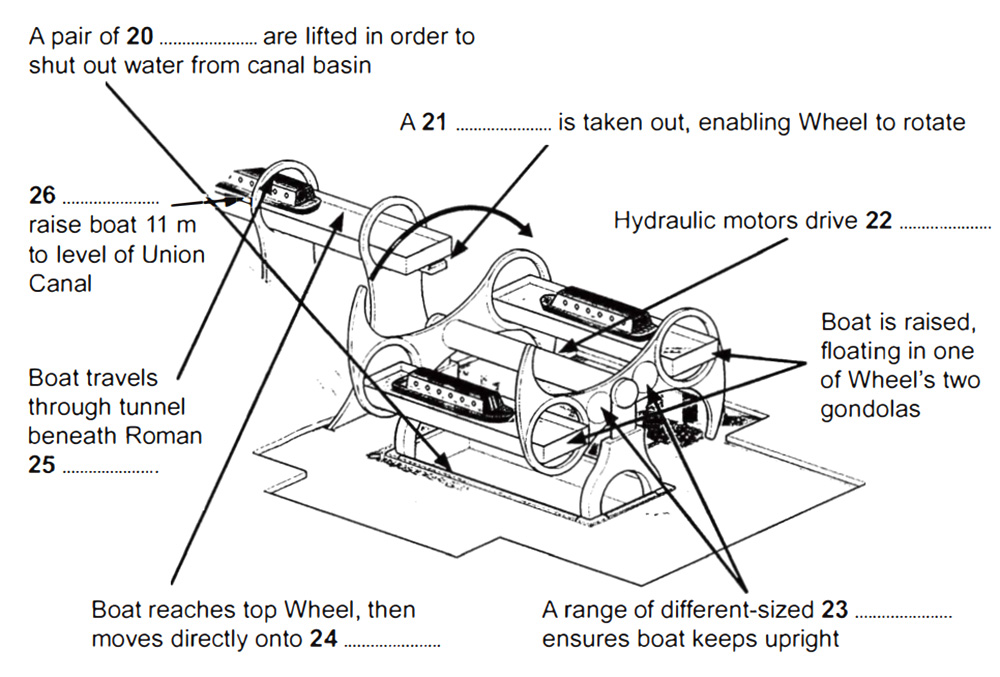
Boats needing to be lifted up enter the culvert basin at the level of the Forth & Clyde Culvert and then enter the lower gondola of the Wheel. Two hydraulic steel gates are raised, so as to seal the gondola off from the water in the canal basin. The water between the gates is then pumped out. A hydraulic clamp, which prevents the artillery of the Wheel moving while the gondola is docked, is removed, allowing the Cycle to turn. In the central machine room an array of ten hydraulic motors then begins to rotate the central axle. The beam connects to the outer arms of the Wheel, which begin to rotate at a speed of one/viii of a revolution per minute. As the cycle rotates, the gondolas are kept in the upright position by a elementary gearing system. 2 eight-metre-wide cogs orbit a stock-still inner cog of the aforementioned width, connected by 2 smaller cogs travelling in the opposite direction to the outer cogs – so ensuring that the gondolas e'er remain level. When the gondola reaches the top, the boat passes straight onto the channel situated 24 metres above the culvert basin.
The remaining 11 metres of lift needed to achieve the Union Canal is achieved by ways of a pair of locks. The Wheel could not be constructed to drag boats over the total 35-metre deviation betwixt the two canals, attributable to the presence of the historically important Antonine Wall, which was built past the Romans in the second century Advert. Boats travel under this wall via a tunnel, then through the locks, and finally on to the Union Culvert.
Questions 14-19
Do the following statements agree with the information given in Reading Passage 2?
In boxes 14-19 on your answer canvas, write
Truthful if the statement agrees with the information
Faux if the statement contradicts the information
Non GIVEN if at that place is no information on this
14 The Falkirk Cycle has linked the Forth & Clyde Canal with the Union Canal for the offset time in their history.
fifteen At that place was some opposition to the pattern of the Falkirk Wheel at first.
sixteen The Falkirk Wheel was initially put together at the location where its components were manufactured.
17 The Falkirk Bicycle is the only boat lift in the world which has steel sections bolted together by hand.
18 The weight of the gondolas varies according to the size of boat being carried.
19 The construction of the Falkirk Wheel site took into account the presence of a nearby aboriginal monument.
Questions 20-26
Label the diagram below.
Choose ONE Give-and-take from the passage for each answer.
Write your answers in boxes 20-26 on your answer canvas.
How a gunkhole is lifted on the Falkirk Wheel
mcgregorrawas1947.blogspot.com
Source: https://ieltstrainingonline.com/practice-cambridge-ielts-11-reading-test-01-with-answer/

Post a Comment for "Cambridge Ielts 11 Reading Test 1 Pdf"